What "Chat With Your Documents" Tools Get Wrong About Retrieval
Most AI document tools market the model. The thing that actually decides whether an answer is right or confidently wrong is retrieval, and almost nobody talks about it.
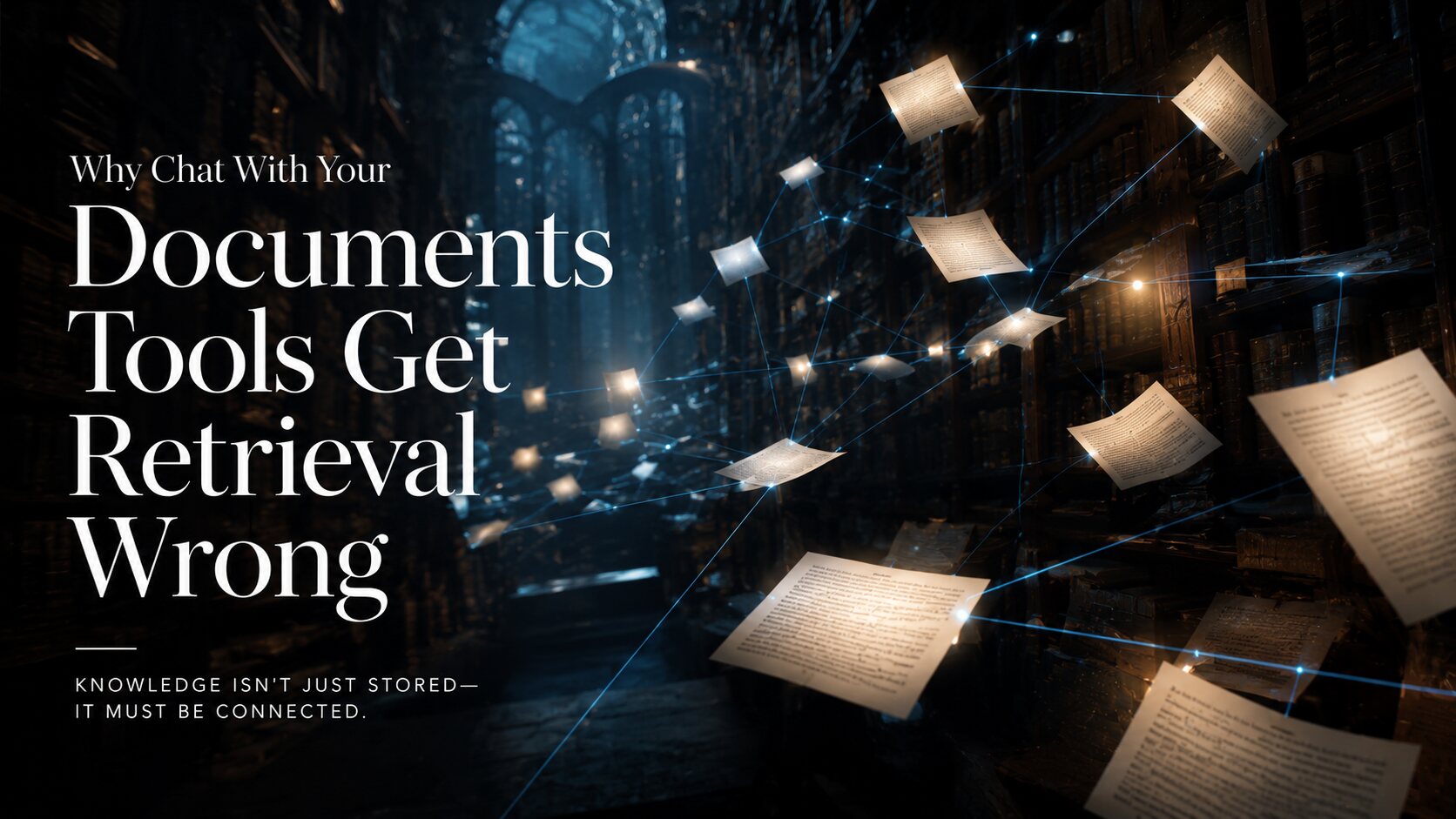
Almost every “chat with your PDF” product markets the language model as the star of the show, which model, how large, how fast. The thing that actually decides whether an answer is right or confidently wrong almost never gets mentioned, and it isn't the model. It's retrieval: whether the system handed the model the right five paragraphs before asking it to answer.
That omission isn't an accident. “Powered by a bigger model” is an easy thing to put on a landing page. “Our chunking strategy handles your document's structure well” is not, even though the second sentence is a far better predictor of whether the tool will actually work on the document you care about.
The Question Everyone Skips: Where Did That Answer Come From?
A question about a document can be answered two fundamentally different ways, and from the outside they can look identical. The model can answer from its own training data (a general, plausible-sounding response about the topic) or it can answer from the specific document you handed it. Only one of those is actually reading your file.
This distinction matters most exactly when it's hardest to notice: when the document contradicts common knowledge, or contains a specific number, date, or decision that only exists in that file. A model answering from general training data will still produce something fluent and plausible in that moment. It just won't be about your document, and there's no visible seam in the response to tell you that's what happened.
| Model's own knowledge | Retrieval over your document | |
|---|---|---|
| Source of the answer | General training data | The document or video itself |
| Fails silently when wrong? | Yes, sounds confident either way | No, retrieval has nothing relevant to surface |
| Improves with a better source doc? | No | Yes |
Retrieval-Augmented Generation, Briefly
The mechanism is simpler than the name suggests. Extract the raw text from a source, split it into overlapping chunks, embed those chunks, and store them so they can be searched. When a question comes in, retrieve the chunks most relevant to it and hand those (not the whole document) to the model alongside the question. The answer gets generated from the actual retrieved material, not from the model's memory of the general topic.
The reason for chunking instead of handing over the whole document at once is mostly practical: a model's context window is finite, and even when a document fits inside it, most of that context is irrelevant to any single question. Retrieval is the step that narrows a hundred-page document down to the handful of paragraphs actually worth reasoning about; everything downstream depends on that narrowing happening well.
source (PDF, doc, video transcript) -> extract raw text -> split into overlapping chunks -> embed each chunk -> store for retrieval question arrives -> retrieve the most relevant chunks -> pass chunks + question to the model -> answer is grounded in what was retrievedWhy Retrieval Quality Is Invisible From the Outside
Here's what makes this genuinely hard to evaluate as a user: you can't see what got retrieved unless the tool chooses to show you. Two products can answer the exact same question about the exact same document, one grounded correctly and one quietly hallucinating from general knowledge, and the response text alone won't tell you which is which. Both will sound confident. Both will sound plausible. The only real tell is whether the answer holds up against the actual document, which most people never bother to check because the answer sounded right.
This is why “it gave me a good-sounding answer once” is a weak way to evaluate one of these tools. A good-sounding answer is the minimum bar a language model clears by default; it's what these models are trained to produce regardless of whether the underlying facts are correct. The actual test is asking something the document explicitly gets wrong, or something oddly specific that only the document would know, and seeing whether the tool surfaces that specific detail or a generic-sounding paraphrase around it.
Why a Better Model Doesn't Fix Bad Retrieval
This is the part that's easy to miss when evaluating one of these tools: a strong model reasoning over the wrong chunks still produces a confidently wrong answer, because it's reasoning correctly from bad material. The failure looks like a model problem from the outside (the tone is right, the sentence is fluent, the fact is wrong), but it's almost always upstream of the model entirely, in what got retrieved before the model ever saw the question.
The practical implication is simple: when you're judging one of these tools, ask about the retrieval pipeline before you ask which model powers it. The model is doing exactly what it's supposed to, answering the question in front of it. The question is whether the material in front of it was the right material.
Treating a Video Like Any Other Document
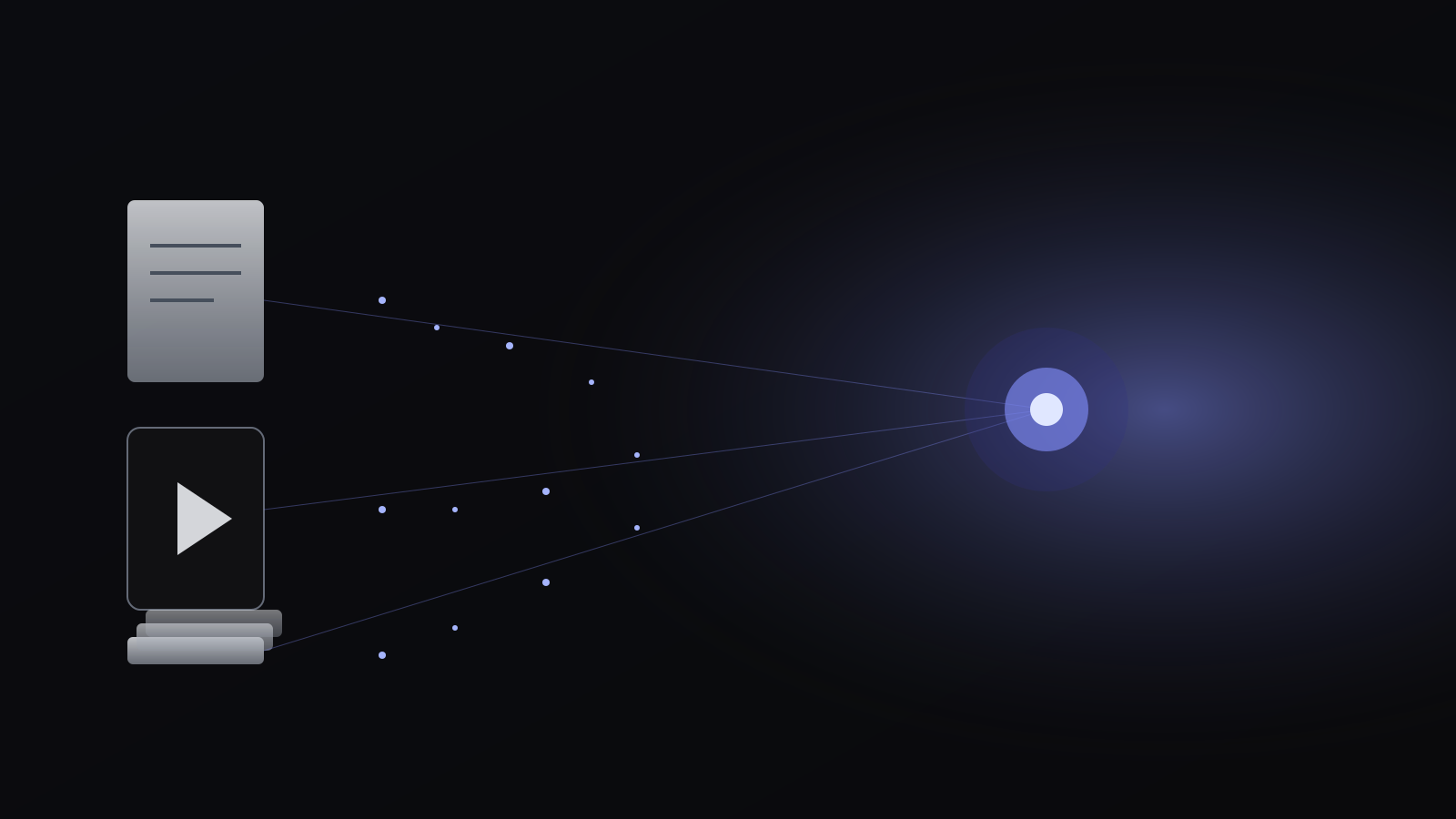
DocMind AI's retrieval pipeline treats a YouTube video as just another source rather than building a second, separate system for it. Instead of asking anyone to watch or transcribe anything manually, the video's transcript gets pulled and routed through the exact same extract, chunk, embed, and retrieve flow as a PDF or a document. The practical result is that a long lecture or interview becomes just as searchable and summarizable as a two-page file, because architecturally, it's being treated as one.
That's a deliberate economy, not an accident: video and text are the same retrieval problem wearing different source formats, and building two separate pipelines for what's fundamentally one problem is the kind of complexity that pays no rent. The tempting alternative (a bespoke video pipeline with its own summarization logic, its own retrieval quirks) would have doubled the surface area to maintain for a difference that, once you have a transcript, mostly stops mattering.
The one place the format difference doesn't disappear is data quality going in, which is exactly the honest caveat the next section is about.
The Parts That Are Still Genuinely Hard
It would be easy to describe this as a solved problem. It isn't, and it's more useful to say so plainly. Chunking strategy is a real, unresolved tradeoff; chunks too small lose surrounding context, chunks too large dilute relevance and start dragging in material the question wasn't actually about. YouTube transcripts are frequently messy and auto-generated, which makes clean chunking harder than it is for a well-formatted PDF. And keeping conversational context across a run of follow-up questions, rather than treating each one as if it arrived cold, is still being worked through rather than finished.
The chunking tradeoff in particular is worth sitting with, because it doesn't have a universally correct answer; it depends on the shape of the source. A legal contract full of cross-referencing clauses wants larger, more context-preserving chunks. A FAQ made of short, self-contained answers wants small ones. A tool that picks one chunk size and applies it to every document uploaded is making an implicit bet that all documents have the same shape, which they don't.
Auto-generated transcripts add a second layer of noise on top of that: missing punctuation, run-on sentences, the occasional misheard word standing in for a real one. Chunking that already has to guess at where one idea ends and the next begins gets meaningfully harder when the text itself doesn't reliably mark those boundaries. None of this is a reason to avoid treating video as a document, it's a reason to be honest that the shared pipeline still has rough edges specific to that source type, even while the architecture stays the same.
What to Actually Look For in One of These Tools
- Does it show which passages an answer actually came from, or just assert a conclusion?
- Does it fail honestly when nothing relevant exists in the source, or does it guess?
- Does it treat different source types through one coherent pipeline, or bolt on a separate system per format?
- Does a better, more specific source document actually produce a better answer?
The biggest lesson from actually building this so far has been resisting the urge to fix a bad answer by reaching for a bigger or newer model. Most of the time, the fix was upstream, a chunk boundary landing in the wrong place, a transcript that needed cleaning before it was embedded, a retrieval step returning technically-relevant-but-not-actually-useful passages. It's a less satisfying fix than swapping in a better model, and it's almost always the correct one.
Conclusion
None of this shows up in a comparison chart of model names, context window sizes, or price per token, which is exactly why it's worth asking about directly instead of assuming the biggest model wins. The question that actually predicts whether one of these tools will work on your document isn't which model is behind it. It's whether the system finds the right five paragraphs before it starts writing.
Retrieval is the unglamorous half of any “chat with your documents” product, which is exactly why it's the half that gets skipped in the marketing. The model is rarely the reason these tools get something wrong. The reason is almost always further upstream, in whether the system found the right five paragraphs before it ever started writing an answer.